Voice Actors for AI Training: How the Industry Works
The AI voice industry changed everything about how synthetic speech gets made. What took years of careful engineering now takes seconds. But here's what most people don't talk about: none of it works without human voices to learn from first.
AI companies need massive datasets of clean, varied, expressive human speech. They need whispers and shouts. They need different accents, ages, and emotional registers. They need voices recorded in controlled conditions with consistent equipment. And they need a lot of them.
That's created real work for voice actors. Not the kind where you deliver the final product, but the kind where your voice becomes the raw material. You record scripts. You read phoneme lists. You say the same phrase twenty different ways. And then a neural network learns from all of it.
This guide covers how that work actually functions, what it pays, what you're agreeing to when you sign an AI training contract, and how to approach the whole thing without giving away more than you intend. Whether you're a professional voice actor looking to diversify income or someone just getting into voice work, understanding this industry matters right now.
 Photo on Unsplash
What AI companies actually need from voice actors
Training a speech AI isn't like recording an audiobook. The requirements are different, the session structures are different, and the outputs look nothing like what traditional voice work produces.
A modern text-to-speech system needs to learn how to map written text to audio that sounds human. To do that, the model needs thousands of hours of clean, labeled audio. It needs to hear the same speaker saying many different things, in many different emotional states, at different speaking speeds. The more variety and the more data, the better the model gets.
The data collection layer
At the most basic level, AI companies collect speech data the same way any research project collects data. They hire people to say things into microphones. The recordings get labeled, cleaned, and fed into training pipelines.
This kind of work is everywhere right now. Companies building voice assistants, navigation apps, call center automation, and accessibility tools all need fresh training data on a regular basis. They post jobs on platforms like Voices.com, Casting Call Club, and specialized AI data marketplaces. The work is often repetitive but doesn't require you to be a professional voice actor. You just need to sound clear and consistent.
Pay varies. Generic data collection for anonymized datasets might pay ten to thirty dollars per hour. You record hundreds of sentences from a provided script, submit the files, and that's it. Your voice gets mixed with thousands of others. No one will ever associate any output with you specifically.
The named voice model
This is where professional voice actors enter with more leverage. Some companies want to build specific AI voices rather than generic speech systems. They're creating a voice with a recognizable character, one that might power a brand mascot, a specific video game character, or an entertainment product.
For that, they typically want someone whose voice has distinctive qualities. Warm. Authoritative. Bright and playful. They hire voice actors who match what they're looking for, record substantial sessions ranging from one to ten hours, and then use those recordings to build a model tuned specifically to that performer's sound.
The model can then synthesize new audio that sounds like that voice actor saying things they never actually recorded. The company can generate unlimited content without paying hourly rates. That's a significant transfer of value, which is why these contracts command higher fees than generic data work.
Celebrity and licensed voices
At the highest end sits the licensing of well-known voices. When a famous actor, news anchor, or public figure agrees to let a company build an AI version of their voice, they're typically doing it through a formal licensing deal. They get paid upfront, ongoing royalties, or both. Usage rights might be limited to specific contexts, languages, or time periods.
Platforms like TryAIVoices let content creators access AI voices built on these kinds of arrangements. The voice library at TryAIVoices includes hundreds of celebrity voices, politicians, musicians, cartoon characters, movie characters, and more. Those voices represent real underlying voice data and real underlying agreements. Someone recorded something for something to make those models work.
Types of AI voice training work available
Not all AI voice work is the same. The category you're in determines what you record, what you get paid, and what rights you're transferring.
 Photo on Unsplash
Generic speech dataset contribution
The most accessible category. Companies building foundational speech models need breadth, not depth. They want recordings from many different speakers across many demographics. Age, gender, accent, vocal quality, regional dialect. Diversity of voice type matters more than quality of any individual performer.
Work in this category feels more like survey-taking than voice acting. You might record five hundred short sentences in a single session, all in a neutral delivery. You're not performing. You're generating data points.
The pay reflects this. Hourly rates range from eight to thirty dollars depending on the company and platform. Some offer flat project rates. You might earn two hundred dollars for four hours of clean recording. It's not spectacular, but it's consistent work if you want it.
Your voice in this context gets used to improve general speech recognition accuracy, train TTS baseline models, or benchmark new architectures. It's not going to produce a product that sounds like you. It's contributing to systems that will sound more natural in general.
Named character voice licensing
A step up in complexity and compensation. Here you're not just a data point. You're the foundation for a specific voice product. The company wants something that sounds distinctly like you, and they'll build a model designed to replicate your specific vocal characteristics.
Sessions for this type of work run longer. Three to ten hours of recording is common, spread across multiple sessions to capture consistency. You'll read diverse content, phoneme sets designed to cover every sound in the target language, scripts with emotional range, and sometimes material specifically chosen to stress-test your vocal qualities.
Pay for this type of work has risen substantially as demand increased. Named character voice work can command three hundred to over a thousand dollars per session depending on your profile and the company's budget. The higher rates typically come with more restrictive contracts.
Full voice cloning with perpetual license
The most financially lucrative option, but also the one that demands the most careful contract review. Companies sometimes want more than just enough data to build a voice. They want to own all the results of that data, in perpetuity, across all use cases, without further compensation.
These deals look attractive at first glance. Upfront payments of five thousand, ten thousand, or more. But the math only works in your favor if the resulting voice model has limited commercial value. When a company generates millions of dollars of content with your voice, a flat buyout looks very different in retrospect.
The question isn't just what you're getting paid. It's what the company expects to generate from that voice. Ask directly. Read the IP clauses carefully. Understand what "perpetual, irrevocable, worldwide license" actually means for your career before you sign.
Royalty-based voice licensing
A growing alternative to flat buyouts. Some companies offer per-use royalties, meaning every time someone generates audio using your voice model, you receive a small percentage of the fee they paid.
This model aligns your interests with the company's success. If the voice model becomes popular, you benefit from that popularity. If it gets used once and abandoned, you earned a small upfront minimum.
The risk is that royalty calculations can be opaque, and enforcement depends on the company's goodwill and financial stability. If the company gets acquired or changes its pricing model, the royalty arrangement may not survive. Get everything in writing, and make sure the contract includes audit rights so you can verify the numbers independently.
Where to find voice AI training opportunities
Finding legitimate work in this category takes more than a quick job board search, but the opportunities are real and growing.
Specialized platforms and marketplaces
Several platforms built specifically for connecting voice talent to AI training projects have emerged. Voices.com, Voice123, and Casting Call Club all have sections for AI voice projects. The work posted there ranges from data collection gigs paying twenty dollars to major named voice contracts paying thousands.
Read the job descriptions carefully. Look for clear statements about how your voice will be used, who will own the recordings, and what the compensation structure looks like. Vague descriptions about "data collection for machine learning purposes" with no details about IP are worth probing before you accept.
Direct outreach to AI companies
Companies building voice products often have ongoing needs that don't get posted publicly. If you have a distinctive or commercially attractive voice, direct outreach to AI companies, game developers, or tech startups can open doors.
Research companies actively building voice products. Look for ones whose existing products use voices similar to yours. A brief, professional inquiry explaining your background and offering your voice for evaluation often gets a response, especially at smaller companies that don't have dedicated casting pipelines yet.
The gaming and entertainment route
Game developers building character-heavy titles need AI voice models to fill dialogue gaps and generate variation without booking actors for every line. This is a growing part of the industry.
Companies building games with gaming characters or anime-style content may want voices that fit specific character archetypes. The same is true for entertainment platforms that use streamer-style voices for content generation.
If you can pitch your voice as fitting an archetype that companies in these verticals need, the conversations become more natural. "I can do the authoritative narrator," or "my voice fits the wise mentor archetype" resonates more than a generic pitch.
Research institutions and universities
Academic labs studying speech synthesis often need training data too. The pay is lower than commercial projects, typically on par with generic data collection rates. But the contracts tend to be cleaner because research institutions have ethics review boards that scrutinize data collection practices.
Working with universities also produces academic citations and papers. If voice AI training is something you want to develop expertise in, having your contributions documented in research gives you credibility that commercial projects often don't.
 Photo on Unsplash
What a recording session actually looks like
Understanding the mechanics before you book your first session prevents a lot of surprises.
Pre-session prep
Most companies send scripts ahead of time so you can review the material. Phoneme-focused scripts can feel strange to read, full of nonsense words and isolated syllables. Emotional range scripts might ask you to say the same sentence in a neutral, happy, sad, angry, surprised, and confused delivery. Read it all through before you show up so nothing catches you off guard.
Technical setup matters more for AI training work than for most other voice recording. The company usually has specific requirements for microphone type, sample rate, recording format, and room acoustics. Follow them exactly. Audio recorded with incorrect settings often gets rejected, which means you've worked for nothing.
Session structure
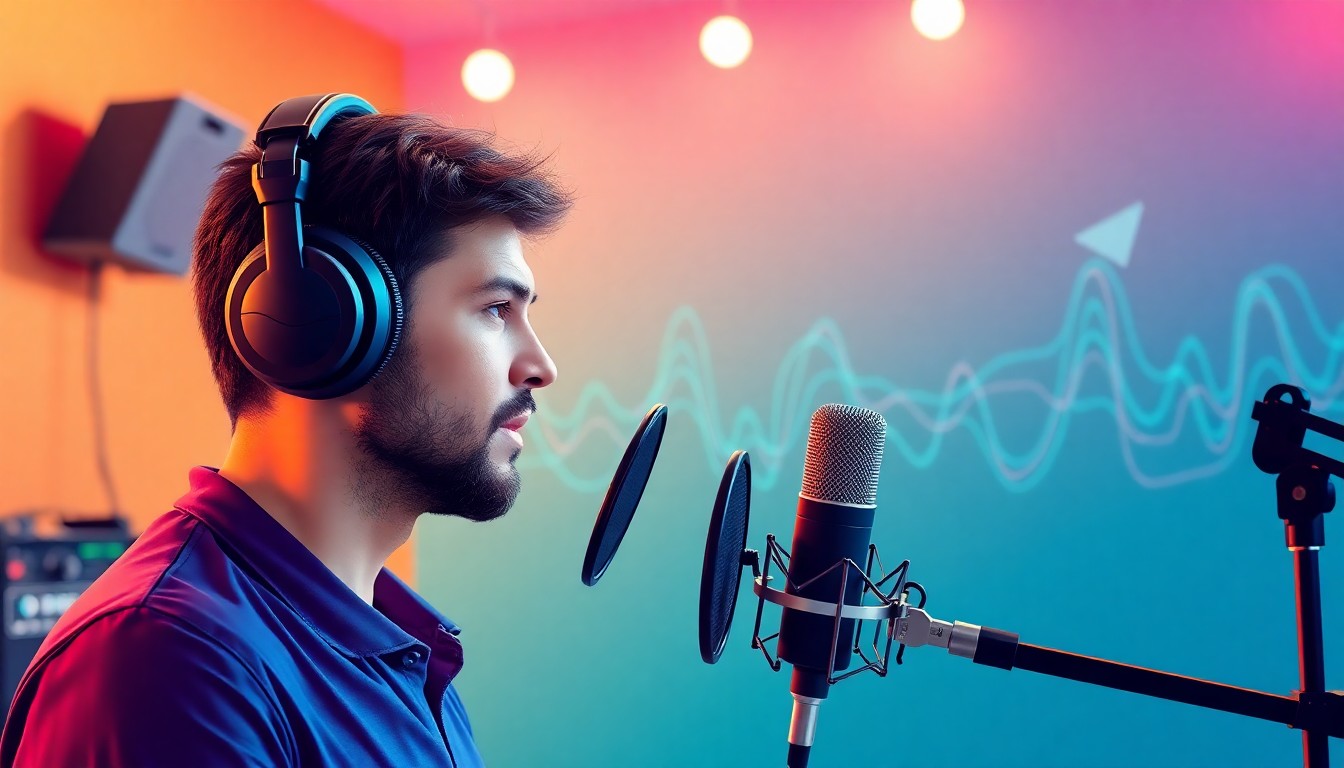
A typical session runs two to four hours. You'll read through prepared scripts while the client or engineer monitors from a control room or via remote connection. They'll flag takes that have noise, stumbles, or unclear articulation, and you'll re-record those sections.
The pacing is different from commercial production work. You're not trying to sell anything or create an emotional impression in the listener. You're generating clean, labeled data. Speed and consistency matter more than performance quality. A clear, accurate read of a sentence is more valuable than a beautifully performed one.
Expect to record the same content multiple times with slight variation in delivery speed, pitch, or emphasis. The model needs to see how your voice handles range, not just a single "perfect" take.
Remote vs. in-studio
Most AI training work happens remotely now. You record in your own studio, upload files to a shared drive or purpose-built platform, and submit. The company reviews, flags problems, and you fix them on a second pass.
This makes the work more accessible but also puts the quality control burden on you. Your home studio setup has to be genuinely good, not just "acceptable for video calls." Professional-quality AI training data needs clean audio with minimal background noise, consistent microphone distance, and no room reverb that the model could learn to associate with your voice signature.
If you're serious about this work, invest in your recording setup. A quality condenser microphone, acoustic treatment, and a good preamp will pay for themselves quickly once you're landing regular sessions.
What voice actors get paid
Compensation in this space has widened considerably as demand increased. The range is real and often confusing. Here's a more structured view.
Data collection rates
- Entry-level platforms: $8-$20 per hour
- Quality-controlled marketplaces: $20-$40 per hour
- Enterprise data collection with specific requirements: $40-$80 per hour
These rates apply to work where your voice goes into a general pool. No one will build a product that sounds specifically like you.
Named voice model work
- Small company or startup: $150-$400 per session hour
- Mid-size company with clear commercial intent: $400-$800 per session
- Major studio or brand: $1,000-$3,000+ per session
These rates vary enormously based on the company's revenue, the intended use case, and your own track record. A voice actor with a strong reel, union credentials, and proven versatility commands different rates than someone just starting.
Licensing deals for character voices
- Indie project with limited scope: $500-$2,000 total
- Commercial product with defined usage scope: $2,000-$10,000
- Major brand mascot or platform integration: $10,000-$50,000+
High-end deals for recognizable characters built on established voice actors can go higher. These are negotiated case by case and often involve IP lawyers on both sides.
Royalty arrangements
Hard to generalize because the percentage, the base calculation, and the minimum guarantees vary so much. A meaningful royalty arrangement might generate $0.001 to $0.01 per audio generation, with minimum guarantees of a few thousand dollars upfront. If a voice gets used millions of times, that adds up. If it doesn't catch on, you've earned your minimum and nothing more.
Understanding AI training contracts
This is where most voice actors who are new to AI work make mistakes. The contracts look like they're mostly standard boilerplate, but the specific clauses around IP, scope, and restrictions can determine how your voice gets used for years or decades.
 Photo on Unsplash
The IP grant clause
Every AI training contract includes language granting the company rights to your voice recordings. The scope of that grant matters enormously.
A narrow grant might read: "Company receives a limited license to use the recorded audio to train a single voice model for use in [specific product] for a period of three years."
A broad grant might read: "You irrevocably assign all rights, title, and interest in the recorded audio and all derivative works, including any AI models trained thereon, to Company in perpetuity worldwide."
Those are very different things. The first limits what the company can do with your recordings and for how long. The second gives them everything, forever, without restriction.
When you see "irrevocable," "perpetual," "worldwide," and "all derivative works" together in the same clause, that's a full assignment of rights. You won't have the ability to request your recordings be deleted. You won't have leverage to renegotiate if the voice model becomes valuable. Read it before you sign.
Usage restrictions
Look for clauses that define what the company can and cannot do with your voice model once it's built. Some contracts restrict use to specific platforms, specific languages, or specific content categories. Others impose no restrictions at all.
Content restrictions matter especially if you have standards about what your voice is associated with. An unrestricted license means the company can use the AI version of your voice to read anything, advertise anything, or narrate content you'd find objectionable. If that concerns you, negotiate restrictions explicitly into the contract.
Non-compete implications
Some AI training contracts include language that limits your ability to work with competitors. Before signing, check whether the contract restricts you from working with other AI voice companies, from licensing your voice elsewhere, or from appearing in competing products for any period of time.
Non-competes in this space can be aggressive. A two-year restriction on working with competitors might not seem like a big deal when you're signing, but it can meaningfully limit your options if AI voice training becomes a larger part of your income.
Deletion rights
Some contracts include provisions allowing you to request your voice data be deleted after a period of time. Others include no such provision. Under some privacy regulations, you may have statutory rights to request deletion of personal data regardless of contract language, but those rights vary by jurisdiction.
If data deletion matters to you, try to get explicit contractual language rather than relying on regulatory protections that may or may not apply to your situation.
The SAG-AFTRA factor
The major voice acting union has been actively responding to AI voice concerns, and that's created both protections and complications for union members.
What the union negotiated
SAG-AFTRA struck historic deals with several major studios and AI companies that established some baseline standards for union members. Those deals typically include:
Informed consent requirements. AI companies covered by the deal must disclose when they're collecting voice data for AI training, explain how it will be used, and get explicit written consent before recording begins.
Minimum compensation floors. Union minimums now apply to AI voice training work just as they apply to traditional voice acting. The rates are higher than what many non-union platforms pay.
Residuals for commercial AI voices. For voice models built on union members' performances, some deals include residual payments triggered by commercial use.
Right to withdraw. Some agreements give members the right to withdraw consent for future use after a defined period, though models already trained typically remain in use.
The complication for non-union voice actors
If you're not a SAG-AFTRA member, those negotiated protections don't apply to you. Non-union voice actors working with companies not covered by union agreements are operating entirely under contract law and general privacy regulations. That puts more responsibility on individual negotiation.
This doesn't mean non-union work is inherently exploitative. Many companies building AI voice products do right by their contributors regardless of union status. But you don't have the institutional backstop that union members have, so your due diligence needs to be correspondingly more thorough.
Ethical considerations and your personal lines
Beyond the legal and financial questions, there's a harder question worth thinking through before you start this work: what are you comfortable with?
Some voice actors have no hesitation contributing to AI systems. They see it as a natural extension of their craft into a new medium. Others feel differently. They worry their voice will be used for content they oppose, that they're contributing to technology that threatens the livelihoods of other voice actors, or that the compensation models don't fairly reflect the value being extracted.
Both positions are reasonable. This is a genuinely contested ethical space.
The replacement question
Content creators on platforms like TryAIVoices use AI voices to generate content at scale that would be economically impossible to produce with traditional voice casting. A single creator can now generate hours of audio in dozens of voice styles, including celebrity voices, animated characters, and politicians, without booking a single voice actor.
That creates real efficiencies for creators. It also removes work from the pool available to voice actors. The question isn't whether this is happening. It is. The question is whether voice actors participating in the system are making things better or worse for the broader community of their colleagues.
One view: if AI voice systems are going to exist regardless, voice actors who participate shape how the systems work and earn income in the process. Sitting out doesn't slow the technology, it just means less representation of legitimate voice actor concerns in the design of these systems.
Another view: providing your voice to build AI training datasets accelerates the replacement of the very profession you're part of, and the economics rarely compensate fairly for that acceleration.
These aren't questions with clean answers. Decide where you stand before you're in a session booth, not after.
What the industry thinks collectively
The AI voice cloning regulation conversation is ongoing and unresolved. Legislative efforts in multiple countries are pushing toward mandatory consent requirements for using voices in AI training. Some jurisdictions have already passed laws requiring disclosure when AI voices are used in commercial contexts.
The industry direction is toward more transparency and more structured consent frameworks. That's a meaningful shift from two years ago, when the norm was vague contracts and minimal disclosure.
Protecting yourself before you sign
Practical checklist for voice actors evaluating AI training opportunities:
Read the IP clause word by word
Don't skim it. Find the section that describes what rights you're granting and read every word. If you see terms you don't understand, look them up or consult a lawyer. A thirty-minute consultation with an entertainment lawyer costs less than the long-term cost of a bad IP transfer.
Ask what the voice model will be used for
Specifically. "Machine learning purposes" is not an answer. Ask what product. Ask who the end users are. Ask whether the model will be used in contexts where it could generate content you'd oppose. If the company won't answer, that tells you something.
Understand the scope of the license
Limited license to a single product for a defined time period is very different from an unlimited license across all contexts forever. Know which one you're agreeing to.
Get the compensation structure in writing
If royalties are promised, the contract must specify the calculation method, the minimum guarantees, the audit rights, and the payment schedule. Oral promises about future royalties are worth nothing.
Check the non-compete scope
Any restriction on your ability to do other voice work should be clearly limited in scope and duration. A one-year restriction on working with direct competitors in the same product category is very different from a two-year restriction on all AI voice work.
Include a content restriction if you want one
If you don't want your voice used for political content, adult content, content in certain languages, or content promoting specific products or companies, say so explicitly. Get the restriction written into the contract. A company serious about a legitimate business will usually accommodate reasonable restrictions.
 Photo on Unsplash
How to build a side income from AI voice training
Voice actors who approach this strategically can build a meaningful income stream without compromising their core work.
Start with data collection to understand the landscape
Before pursuing named voice model contracts, spend a few hours doing generic data collection work. It teaches you what the recording standards look like, how the submission and review process works, and what companies in this space are actually like to work with. Low-stakes entry is better than jumping straight into a contract worth thousands where you don't know what you're doing.
Build relationships, not transactions
The best AI voice training work comes from relationships with companies that know and trust your work. Show up reliably, deliver clean audio, communicate professionally, and follow up after sessions. Companies that find a voice actor who's easy to work with and produces good data return to that person rather than constantly recruiting new contributors.
Position your voice type strategically
Look at what's currently popular in AI voice products. What voice types are in demand? Deep, authoritative voices for assistant applications, bright playful voices for children's content, clear neutral voices for navigation and accessibility tools. If you can identify gaps between what's available and what companies are looking for, you can position yourself more effectively.
Look at the voice library on TryAIVoices and pay attention to what's there and what isn't. The streaming and gaming categories are growing rapidly. The anime voice category has strong demand from content creators. Knowing where demand exists helps you pitch to the right buyers.
Price your named work like a business
Don't underprice named voice model work because you're new to it. If a company is building a commercial product on your voice, they're making a capital investment. Price accordingly. A model that generates significant revenue for a company should command compensation that reflects that expected value.
If you're unsure what to charge, consult resources like the Global Voice Acting Academy, the World-Voices Organization, or other professional voice actor communities that track rate benchmarks in this space.
Getting started this week
If this work interests you, here are concrete first steps.
Create profiles on Voices.com and Voice123 if you haven't already. Both platforms now list AI training projects alongside traditional voice acting gigs. Update your profile to explicitly note that you're open to AI training work and specify any restrictions you want to apply upfront.
Research five to ten AI companies building voice products in categories that interest you. Look at what their existing products sound like. If your voice is a natural fit for something they're building, reach out directly with a brief pitch and a demo reel.
Read at least one sample AI voice training contract before you negotiate one. The AI Now Institute, Electronic Frontier Foundation, and SAG-AFTRA have all published resources and example contract language that will help you understand what standard provisions look like.
Get your home recording setup to professional quality if it isn't already. The income you can generate from quality AI training work will pay for the equipment costs quickly if you land even a few named voice projects.
How TryAIVoices uses AI voice technology
On the creation side of this industry, platforms like TryAIVoices let content creators access AI-generated voices for their projects. The voice library includes voices across dozens of categories, from celebrity voices to gaming characters to political figures.
Creators use these voices to generate voiceovers, character dialogue, social media content, and more. The Obama AI voice, Trump AI voice, Morgan Freeman AI voice, and Elon Musk AI voice are among the most-used on the platform, each representing careful synthesis work built on extensive training data.
For content creators looking to understand what AI voices sound like before committing to a project, trying them through a platform like TryAIVoices is a good first step. Browse the full voice library to see the range available. Subscription plans cover unlimited generation at the Pro and Unlimited tiers, making it practical for creators who need volume.
Frequently asked questions
How much do voice actors get paid for AI training?
It depends heavily on the type of work. Generic data collection for anonymized datasets pays eight to forty dollars per hour. Named voice model work, where you're the foundation for a specific AI voice product, typically commands three hundred to over a thousand dollars per session. Full licensed voice deals can be five thousand to fifty thousand dollars or more depending on commercial scope and your professional profile.
Do you need to be a professional voice actor to do AI voice training work?
No, not for all types. Generic speech dataset collection work is open to most people with clear speech and a reasonably quiet recording environment. Named character voice work does benefit from professional experience because the sessions are more demanding and the standards for audio quality are higher.
What are the biggest red flags in an AI voice training contract?
Unlimited perpetual irrevocable licenses with no usage restrictions are the most significant flag. Other red flags include vague language about how the voice will be used, royalty promises without calculation details, and broad non-compete clauses. Any contract that's vague about what they're building should be questioned before you sign.
Can I request that my voice be removed from an AI model after it's trained?
It depends on what the contract says and where you're located. Some contracts include deletion rights. Some jurisdictions have privacy laws that create deletion rights independent of contract terms. Once a model is trained, technical deletion of your specific contribution is often difficult even with the best intentions, but unused training data can typically be deleted.
Does SAG-AFTRA membership protect me in AI voice training work?
It depends on whether the company is covered by a SAG-AFTRA agreement. Major studios and some AI companies have signed deals that provide minimums, consent protections, and residual structures for union members. Companies not covered by those deals aren't bound by them. Check whether a specific company has a SAG-AFTRA agreement before assuming union protections apply.
Is doing AI voice training work bad for the voice acting profession?
This is genuinely contested. There are legitimate arguments on both sides. Participating voices do receive compensation and can influence how these systems are built. The technology also does reduce demand for traditional voice booking in some contexts. Where you draw your own line on this is a personal decision that should be made with clear information rather than panic or uncritical optimism.
How do I find legitimate AI voice training opportunities?
Start with Voices.com, Voice123, and Casting Call Club. Research AI companies directly and reach out to ones building products that match your vocal type. SAG-AFTRA's website lists companies with active agreements. The Global Voice Acting Academy and similar professional communities maintain resources on emerging opportunities in the AI space.
Related voices to try
Related guides
Voice actors for AI training sit at a unique intersection right now. The market exists, the compensation is real, and the work is growing. The risks are also real and worth understanding before you commit.
Take your time with contracts. Know what you're giving up. Price your work like a business, not a favor. And decide in advance what limits matter to you so that decision isn't made under pressure in the middle of a negotiation.
Start exploring with TryAIVoices today to see what AI voice technology produces when it's working well. Understanding the output helps you understand what the input, your voice, is actually worth.